Self-Rated Health
States with the Worst Self-Rated Health
#1 = worst self-rated health
- Period
- 2024
- Last updated
What the data shows
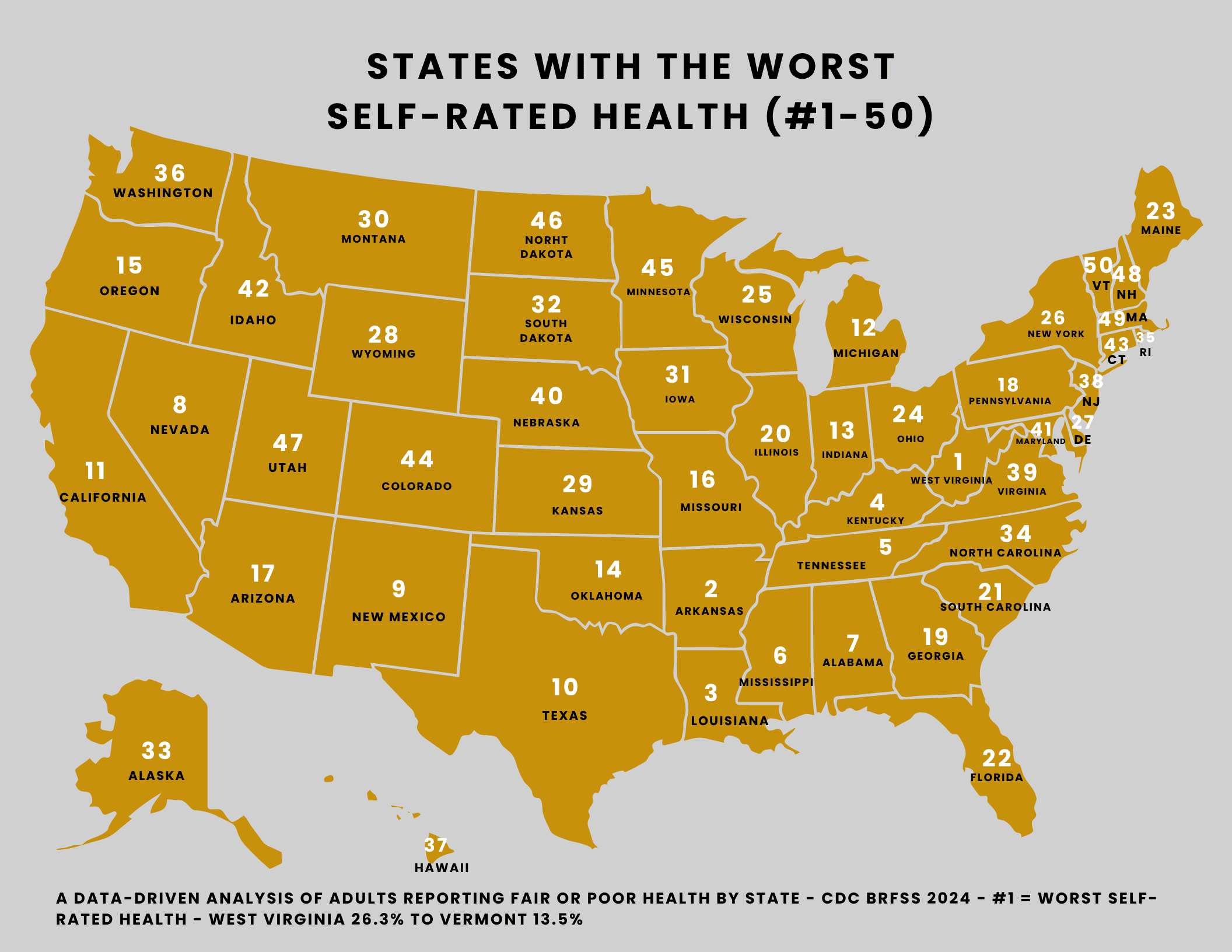
About 1 in 4 adults in West Virginia (26.31%) describe their own health as only fair or poor — the highest share of any state, and nearly double the 13.52% in Vermont, which ranks last. What stands out about this ranking is how geographically tidy it is: the entire top five sits in one corner of the map.
That cluster is Appalachia and the Mid-South. West Virginia leads, followed by Arkansas (24.7%), Louisiana (24.14%), Kentucky (23.94%), and Tennessee (23.4%) — five neighboring states stacked at the top. The bottom of the list, meanwhile, belongs to New England: Massachusetts (14.79%) and Vermont (13.52%) sit at #49 and #50. So the question this map raises isn't "why are the worst states so spread out" — it's the opposite. Why does one region keep landing here?
The likely answer is that self-rated health works as a kind of summary of everything else. This metric doesn't measure any single condition; it asks people one broad question about how healthy they feel overall. And the state at the top of *this* ranking tops our disease-specific maps too. West Virginia isn't only #1 for the worst self-rated health — across our other CDC maps it's also #1 for obesity (41.4%), #1 for adult smoking (20.78%), #1 for arthritis (41.22%), #1 for depression (30.22%), and #1 for diabetes (18.36%). When a state leads the country on that many separate measures of chronic illness, it makes sense that its residents would also rate their own health worst. Self-rated health appears to track the real burden those other maps capture one condition at a time.
It's worth being careful about what the number is, though. This is a subjective, self-reported rating — how people *perceive* their own health, not a clinical exam or a count of diagnoses. Perception is shaped by expectations, local norms, and what people consider "normal" around them, so two people in similar physical shape might rate themselves differently. That subjectivity is a feature here rather than a flaw: it captures lived experience that lab values miss. But it means a high rank likely reflects a genuinely heavier health burden *combined with* how heavily residents feel it — closely related to, but not identical to, any one objective measure. The honest read is that this map shows where Americans feel least healthy, and that feeling lines up tightly with where chronic disease is most concentrated.
A note on method: every state here comes from the same CDC survey (BRFSS), one year, and one definition — adults rating their own health "fair" or "poor" — so the 50-state comparison is apples-to-apples. The one exception is Tennessee, shown with its 2023 value, because CDC had not released a 2024 figure for it; it is flagged per-row. Cross-map figures cited above come from our other CDC maps for the same period. The numbers are CDC's; the ranking and analysis are ours.
Full ranking — all 50 states
Sort by rank, state, or value. Ranks are ordinal (1 = highest by this metric). Ties are broken alphabetically by state name.
| Note | |||
|---|---|---|---|
| 1st | West Virginia | 26.31% | CDC BRFSS, adults reporting fair or poor health, 2024 |
| 2nd | Arkansas | 24.7% | CDC BRFSS, adults reporting fair or poor health, 2024 |
| 3rd | Louisiana | 24.14% | CDC BRFSS, adults reporting fair or poor health, 2024 |
| 4th | Kentucky | 23.94% | CDC BRFSS, adults reporting fair or poor health, 2024 |
| 5th | Tennessee | 23.4% | CDC BRFSS, adults reporting fair or poor health, 2024 (state value is 2023, latest available) |
| 6th | Mississippi | 23.02% | CDC BRFSS, adults reporting fair or poor health, 2024 |
| 7th | Alabama | 22.08% | CDC BRFSS, adults reporting fair or poor health, 2024 |
| 8th | Nevada | 21.91% | CDC BRFSS, adults reporting fair or poor health, 2024 |
| 9th | New Mexico | 21.47% | CDC BRFSS, adults reporting fair or poor health, 2024 |
| 10th | Texas | 21.23% | CDC BRFSS, adults reporting fair or poor health, 2024 |
| 11th | California | 21.13% | CDC BRFSS, adults reporting fair or poor health, 2024 |
| 12th | Michigan | 21.12% | CDC BRFSS, adults reporting fair or poor health, 2024 |
| 13th | Indiana | 20.89% | CDC BRFSS, adults reporting fair or poor health, 2024 |
| 14th | Oklahoma | 20.86% | CDC BRFSS, adults reporting fair or poor health, 2024 |
| 15th | Oregon | 20.67% | CDC BRFSS, adults reporting fair or poor health, 2024 |
| 16th | Missouri | 20.07% | CDC BRFSS, adults reporting fair or poor health, 2024 |
| 17th | Arizona | 20.06% | CDC BRFSS, adults reporting fair or poor health, 2024 |
| 18th | Pennsylvania | 19.98% | CDC BRFSS, adults reporting fair or poor health, 2024 |
| 19th | Georgia | 19.91% | CDC BRFSS, adults reporting fair or poor health, 2024 |
| 20th | Illinois | 19.8% | CDC BRFSS, adults reporting fair or poor health, 2024 |
| 21st | South Carolina | 19.68% | CDC BRFSS, adults reporting fair or poor health, 2024 |
| 22nd | Florida | 19.39% | CDC BRFSS, adults reporting fair or poor health, 2024 |
| 23rd | Maine | 19.17% | CDC BRFSS, adults reporting fair or poor health, 2024 |
| 24th | Ohio | 19.09% | CDC BRFSS, adults reporting fair or poor health, 2024 |
| 25th | Wisconsin | 19.05% | CDC BRFSS, adults reporting fair or poor health, 2024 |
| 26th | New York | 18.59% | CDC BRFSS, adults reporting fair or poor health, 2024 |
| 27th | Delaware | 18.57% | CDC BRFSS, adults reporting fair or poor health, 2024 |
| 28th | Wyoming | 18.34% | CDC BRFSS, adults reporting fair or poor health, 2024 |
| 29th | Kansas | 18.07% | CDC BRFSS, adults reporting fair or poor health, 2024 |
| 30th | Montana | 18.03% | CDC BRFSS, adults reporting fair or poor health, 2024 |
| 31st | Iowa | 17.98% | CDC BRFSS, adults reporting fair or poor health, 2024 |
| 32nd | South Dakota | 17.87% | CDC BRFSS, adults reporting fair or poor health, 2024 |
| 33rd | Alaska | 17.73% | CDC BRFSS, adults reporting fair or poor health, 2024 |
| 34th | North Carolina | 17.58% | CDC BRFSS, adults reporting fair or poor health, 2024 |
| 35th | Rhode Island | 17.33% | CDC BRFSS, adults reporting fair or poor health, 2024 |
| 36th | Washington | 17.23% | CDC BRFSS, adults reporting fair or poor health, 2024 |
| 37th | Hawaii | 17.06% | CDC BRFSS, adults reporting fair or poor health, 2024 |
| 38th | New Jersey | 16.9% | CDC BRFSS, adults reporting fair or poor health, 2024 |
| 39th | Virginia | 16.73% | CDC BRFSS, adults reporting fair or poor health, 2024 |
| 40th | Nebraska | 16.56% | CDC BRFSS, adults reporting fair or poor health, 2024 |
| 41st | Maryland | 16.46% | CDC BRFSS, adults reporting fair or poor health, 2024 |
| 42nd | Idaho | 15.98% | CDC BRFSS, adults reporting fair or poor health, 2024 |
| 43rd | Connecticut | 15.68% | CDC BRFSS, adults reporting fair or poor health, 2024 |
| 44th | Colorado | 15.3% | CDC BRFSS, adults reporting fair or poor health, 2024 |
| 45th | Minnesota | 15.21% | CDC BRFSS, adults reporting fair or poor health, 2024 |
| 46th | North Dakota | 15.2% | CDC BRFSS, adults reporting fair or poor health, 2024 |
| 47th | Utah | 15.14% | CDC BRFSS, adults reporting fair or poor health, 2024 |
| 48th | New Hampshire | 15.01% | CDC BRFSS, adults reporting fair or poor health, 2024 |
| 49th | Massachusetts | 14.79% | CDC BRFSS, adults reporting fair or poor health, 2024 |
| 50th | Vermont | 13.52% | CDC BRFSS, adults reporting fair or poor health, 2024 |
Per-row source notes (including any single-year exceptions) are shown on wider screens.
Methodology
CDC BRFSS 2024: share of adults who rate their own health as fair or poor. State-representative survey; #1 = worst. Tennessee shown with its 2023 value (latest available). Percentages are CDC's; ranking and presentation are ours.
Note: CDC BRFSS, adults reporting fair or poor health, 2024 (state value is 2023, latest available)
Ranks are ordinal (1 = highest by this metric). Ties are broken alphabetically by state name.
Source & data
- Source: CDC BRFSS Prevalence Data (2011-present)Tier 1
- Data period: 2024
- Last updated: June 29, 2026
- Refresh cadence: annual
- #1 (West Virginia): 26.31%
Source: CDC BRFSS Prevalence Data (2011-present)
License: Public domain (U.S. Government work)
By MAP SO HARD
Reviewed by MAP SO HARD editorial