Depression
States with the Most Depression
#1 = most depression
- Period
- 2024
- Last updated
What the data shows
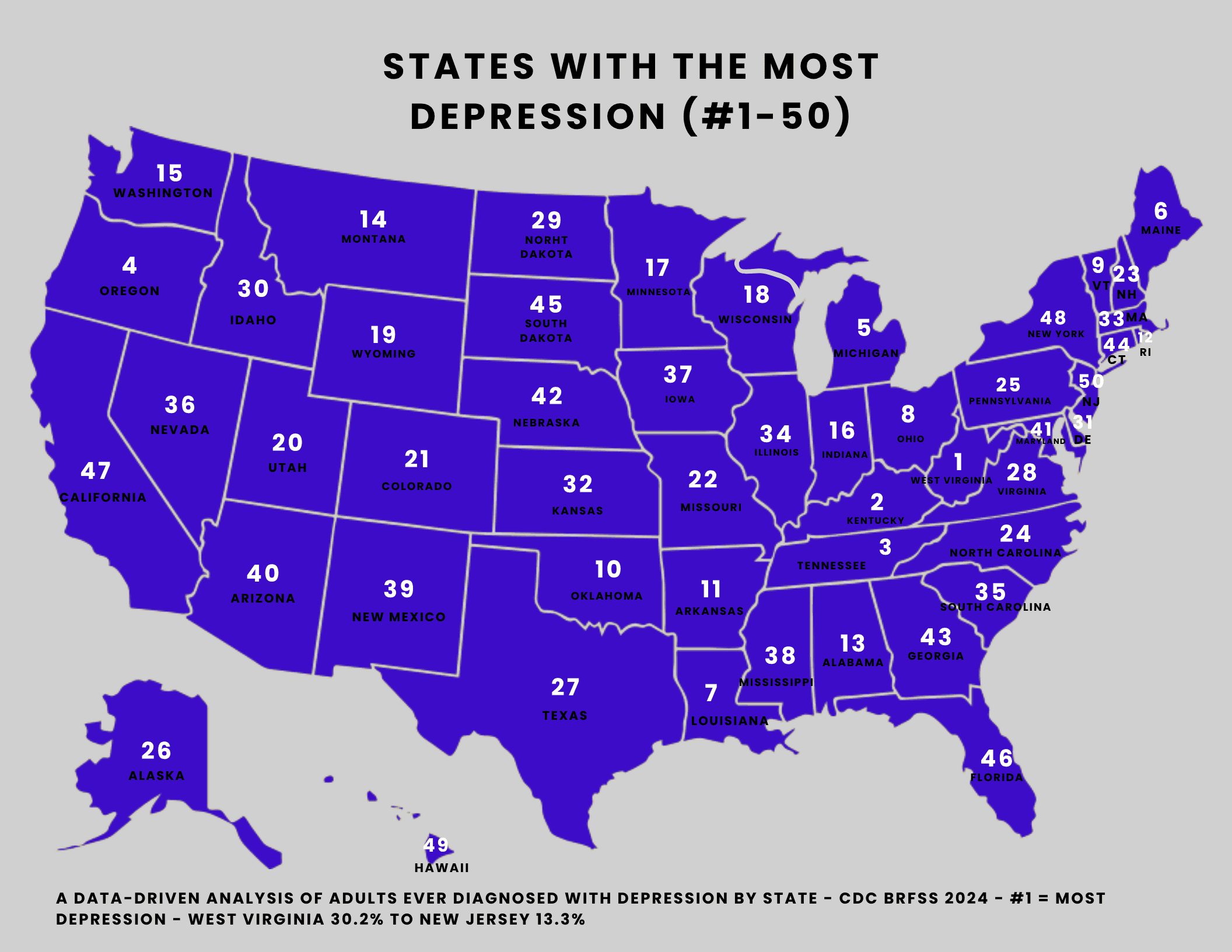
About 3 in 10 adults in West Virginia (30.2%) say a doctor has told them they have a depressive disorder — the highest rate in the country, and more than double the 13.3% in New Jersey, which ranks last. That two-to-one spread is one of the widest in any of our health maps. But unlike most of those maps, the states at the top here don't form a single tidy region — and that turns out to be the most revealing part of the data.
The very top is anchored by Appalachia and the Mid-South: West Virginia, Kentucky (28.3%), and Tennessee (27.3%) take the top three, with Louisiana, Ohio, and Oklahoma close behind. But the rest of the top ten is a different world — Oregon (27.3%), Michigan, Maine, and Vermont all rank among the ten highest. Those aren't states people associate with poor health outcomes; they tend to rank *well* on income, life expectancy, and access to care. So why are they near the top for depression?
The likely answer is the metric itself. This map measures diagnosed depression — adults who say a doctor *told them* they have it — not a clinical screen of everyone. You can't be diagnosed without seeing a provider and being willing to talk about your mental health, so a high rank can mean two very different things: more depression, or more diagnosis. States like Vermont, Maine, and Oregon pair broad health coverage with low stigma around mental-health care, which tends to push diagnosed rates up; Appalachian states likely carry a genuinely heavier burden. The honest read is that this is a map of where depression is most recognized and recorded — closely related to, but not identical to, where it is most common. The states at the bottom (New Jersey, Hawaii at 14.4%, New York at 15.9%) are not necessarily healthier; some of that gap is probably under-diagnosis.
There is a real pattern underneath it all, though. West Virginia is not only #1 for depression — in our other CDC maps it is also #1 for arthritis (41.2%) and #1 for the worst self-rated health (26.3%). A small cluster of Appalachian states keeps landing at the top of one health ranking after another, which points to overlapping, compounding health burdens rather than any single issue.
A note on method: every state here comes from the same CDC survey (BRFSS), one year, one definition, so the 50-state comparison is apples-to-apples. The one exception is Tennessee, shown with its 2023 value, because CDC had not released a 2024 figure for it. Depression diagnoses have trended upward across nearly every state over the past decade, so even the "low" states today report rates that would have looked high a generation ago. The percentages are CDC's; the ranking and the analysis are ours.
Full ranking — all 50 states
Sort by rank, state, or value. Ranks are ordinal (1 = highest by this metric). Ties are broken alphabetically by state name.
| Note | |||
|---|---|---|---|
| 1st | West Virginia | 30.22% | CDC BRFSS, adults ever diagnosed with depression, 2024 |
| 2nd | Kentucky | 28.33% | CDC BRFSS, adults ever diagnosed with depression, 2024 |
| 3rd | Tennessee | 27.3% | CDC BRFSS, adults ever diagnosed with depression, 2024 (state value is 2023, latest available) |
| 4th | Oregon | 27.26% | CDC BRFSS, adults ever diagnosed with depression, 2024 |
| 5th | Michigan | 26.74% | CDC BRFSS, adults ever diagnosed with depression, 2024 |
| 6th | Maine | 26.66% | CDC BRFSS, adults ever diagnosed with depression, 2024 |
| 7th | Louisiana | 26.62% | CDC BRFSS, adults ever diagnosed with depression, 2024 |
| 8th | Ohio | 26.62% | CDC BRFSS, adults ever diagnosed with depression, 2024 |
| 9th | Vermont | 26.43% | CDC BRFSS, adults ever diagnosed with depression, 2024 |
| 10th | Oklahoma | 26.14% | CDC BRFSS, adults ever diagnosed with depression, 2024 |
| 11th | Arkansas | 25.15% | CDC BRFSS, adults ever diagnosed with depression, 2024 |
| 12th | Rhode Island | 24.95% | CDC BRFSS, adults ever diagnosed with depression, 2024 |
| 13th | Alabama | 24.8% | CDC BRFSS, adults ever diagnosed with depression, 2024 |
| 14th | Montana | 24.67% | CDC BRFSS, adults ever diagnosed with depression, 2024 |
| 15th | Washington | 24.57% | CDC BRFSS, adults ever diagnosed with depression, 2024 |
| 16th | Indiana | 24.51% | CDC BRFSS, adults ever diagnosed with depression, 2024 |
| 17th | Minnesota | 24.25% | CDC BRFSS, adults ever diagnosed with depression, 2024 |
| 18th | Wisconsin | 24.13% | CDC BRFSS, adults ever diagnosed with depression, 2024 |
| 19th | Wyoming | 23.97% | CDC BRFSS, adults ever diagnosed with depression, 2024 |
| 20th | Utah | 23.75% | CDC BRFSS, adults ever diagnosed with depression, 2024 |
| 21st | Colorado | 23.04% | CDC BRFSS, adults ever diagnosed with depression, 2024 |
| 22nd | Missouri | 22.96% | CDC BRFSS, adults ever diagnosed with depression, 2024 |
| 23rd | New Hampshire | 22.88% | CDC BRFSS, adults ever diagnosed with depression, 2024 |
| 24th | North Carolina | 22.5% | CDC BRFSS, adults ever diagnosed with depression, 2024 |
| 25th | Pennsylvania | 22.02% | CDC BRFSS, adults ever diagnosed with depression, 2024 |
| 26th | Alaska | 21.91% | CDC BRFSS, adults ever diagnosed with depression, 2024 |
| 27th | Texas | 21.73% | CDC BRFSS, adults ever diagnosed with depression, 2024 |
| 28th | Virginia | 21.68% | CDC BRFSS, adults ever diagnosed with depression, 2024 |
| 29th | North Dakota | 21.63% | CDC BRFSS, adults ever diagnosed with depression, 2024 |
| 30th | Idaho | 21.38% | CDC BRFSS, adults ever diagnosed with depression, 2024 |
| 31st | Delaware | 21.36% | CDC BRFSS, adults ever diagnosed with depression, 2024 |
| 32nd | Kansas | 21.34% | CDC BRFSS, adults ever diagnosed with depression, 2024 |
| 33rd | Massachusetts | 21.05% | CDC BRFSS, adults ever diagnosed with depression, 2024 |
| 34th | Illinois | 20.83% | CDC BRFSS, adults ever diagnosed with depression, 2024 |
| 35th | South Carolina | 20.71% | CDC BRFSS, adults ever diagnosed with depression, 2024 |
| 36th | Nevada | 20.6% | CDC BRFSS, adults ever diagnosed with depression, 2024 |
| 37th | Iowa | 19.81% | CDC BRFSS, adults ever diagnosed with depression, 2024 |
| 38th | Mississippi | 19.71% | CDC BRFSS, adults ever diagnosed with depression, 2024 |
| 39th | New Mexico | 19.2% | CDC BRFSS, adults ever diagnosed with depression, 2024 |
| 40th | Arizona | 19.19% | CDC BRFSS, adults ever diagnosed with depression, 2024 |
| 41st | Maryland | 18.94% | CDC BRFSS, adults ever diagnosed with depression, 2024 |
| 42nd | Nebraska | 18.82% | CDC BRFSS, adults ever diagnosed with depression, 2024 |
| 43rd | Georgia | 18.45% | CDC BRFSS, adults ever diagnosed with depression, 2024 |
| 44th | Connecticut | 18.42% | CDC BRFSS, adults ever diagnosed with depression, 2024 |
| 45th | South Dakota | 18.22% | CDC BRFSS, adults ever diagnosed with depression, 2024 |
| 46th | Florida | 17.94% | CDC BRFSS, adults ever diagnosed with depression, 2024 |
| 47th | California | 17.83% | CDC BRFSS, adults ever diagnosed with depression, 2024 |
| 48th | New York | 15.94% | CDC BRFSS, adults ever diagnosed with depression, 2024 |
| 49th | Hawaii | 14.43% | CDC BRFSS, adults ever diagnosed with depression, 2024 |
| 50th | New Jersey | 13.29% | CDC BRFSS, adults ever diagnosed with depression, 2024 |
Per-row source notes (including any single-year exceptions) are shown on wider screens.
Methodology
CDC BRFSS 2024: share of adults ever told by a doctor they have a form of depression. State-representative survey; #1 = most. Tennessee shown with its 2023 value (latest available). Percentages are CDC's; ranking and presentation are ours.
Note: CDC BRFSS, adults ever diagnosed with depression, 2024 (state value is 2023, latest available)
Ranks are ordinal (1 = highest by this metric). Ties are broken alphabetically by state name.
Source & data
- Source: CDC BRFSS Prevalence Data (2011-present)Tier 1
- Data period: 2024
- Last updated: June 26, 2026
- Refresh cadence: annual
- #1 (West Virginia): 30.22%
Source: CDC BRFSS Prevalence Data (2011-present)
License: Public domain (U.S. Government work)
By MAP SO HARD
Reviewed by MAP SO HARD editorial